

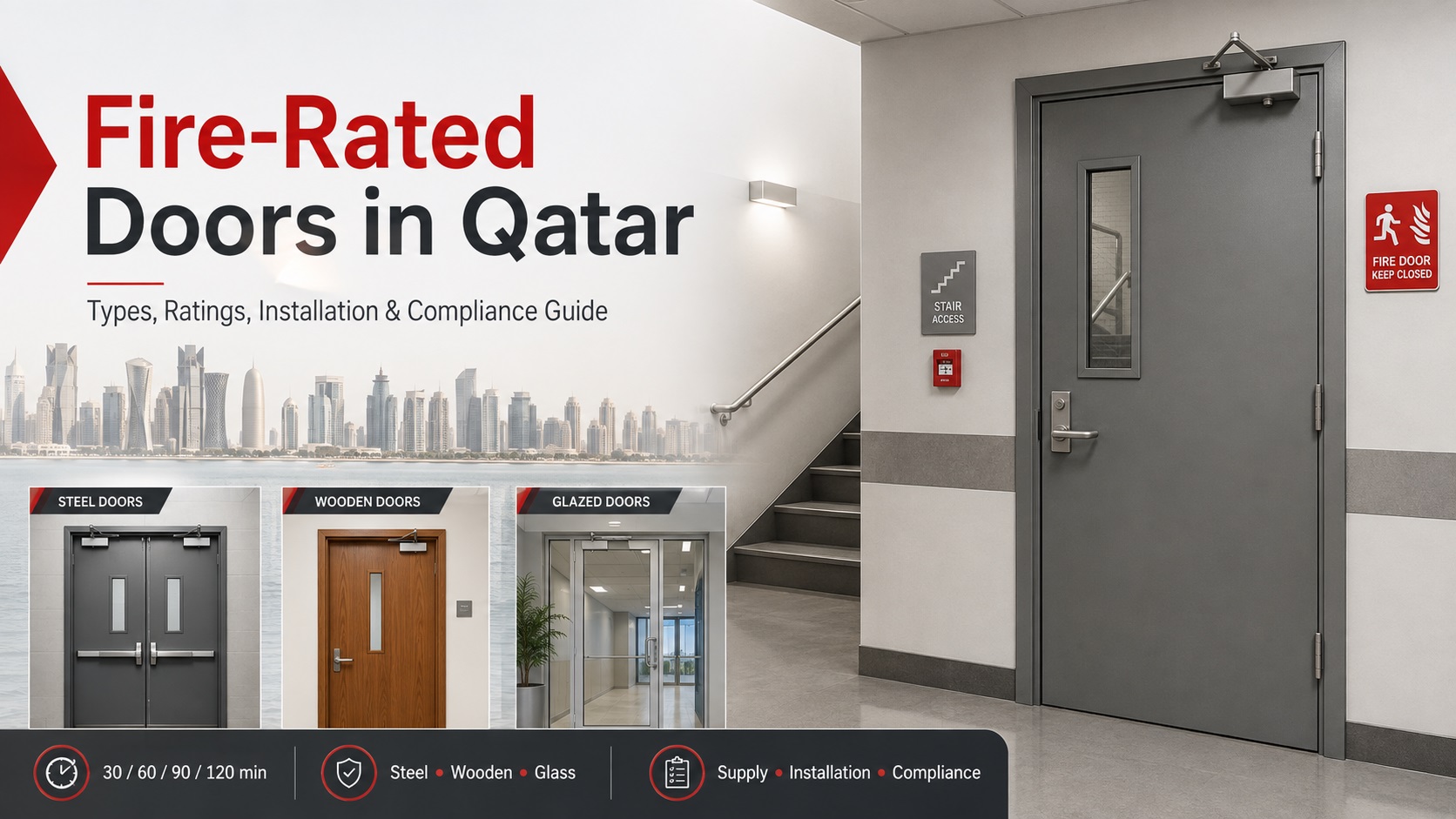
 Fire Rated Doors
Fire-rated doors are one of the most important passive fire protection elements in a building. Unlike fire alarms or suppression systems, they do not need activation, electricity or human operation to begin doing their job. When installed correctly, a fire-rated door helps slow the spread of fire and smoke, protects escape routes and supports the overall fire safety strategy of the building.
For property owners, facility managers, consultants, contractors and business operators in Qatar, choosing the right fire-rated door is not only a safety decision. It is also a compliance, operational and long-term protection decision. A poorly selected or incorrectly installed fire door can affect evacuation safety, approval requirements and the performance of the entire fire compartment.
At Cease Fire Solutions, we supply and install certified fire-rated doors in Qatar for commercial, residential, industrial and institutional buildings. This guide explains what fire-rated doors are, how they work, which ratings are commonly used, where they are installed and what to check before selecting one for your property.
What Is a Fire-Rated Door?
A fire-rated door is a tested door assembly designed to resist fire, heat and smoke for a specific period, such as 30, 60, 90, 120 or 180 minutes. It normally includes the door leaf, frame, hinges, locks, closer, seals, glazing and approved hardware. In Qatar, fire-rated doors are commonly used in staircases, corridors, exits, service rooms, electrical rooms, commercial buildings, towers, hotels, hospitals, warehouses and industrial facilities.
The main purpose of a fire-rated door is not to make a room “fireproof.” Its purpose is to compartmentalize the building so fire and smoke do not spread freely from one area to another. This gives occupants more time to evacuate and helps emergency responders control the incident more effectively.
Need fire-rated doors for a project, authority inspection or building upgrade in Qatar? Cease Fire Solutions can support you with product selection, supply, installation and coordination for compliant fire protection solutions.Call: +974 55324195 | Email: sales@ceasefireme.com
Why Fire-Rated Doors Matter in Qatar
Fire-rated doors are essential in Qatar because many buildings include high-occupancy areas, enclosed corridors, staircases, service shafts, electrical rooms, mechanical spaces, basements, commercial kitchens, storage areas and industrial zones. In these environments, fire and smoke can move quickly if the building is not properly compartmentalized.
A properly installed fire-rated door forms part of the building’s passive fire protection system. It helps divide the property into safer zones and limits the movement of flames, heat and smoke between compartments.
This is especially important in buildings where people may need extra time to evacuate, such as hotels, hospitals, labour accommodations, schools, residential towers, shopping areas and large commercial facilities.
Fire and Smoke Compartmentation
Fire-rated doors help maintain compartmentation by keeping fire within a limited area for a defined period. This prevents the fire from spreading rapidly into escape corridors, staircases or neighbouring rooms.
Smoke is often one of the most dangerous parts of a fire emergency. Even when flames are contained, smoke can travel through gaps around doors and create serious visibility and breathing hazards. For this reason, the door, frame, seals and closing mechanism must all work together as one complete assembly.
Safer Evacuation Routes
Exit corridors and staircases must remain usable for as long as possible during an emergency. Fire-rated doors support this by helping protect escape routes from heat, smoke and flames.
A fire door that does not close properly, has missing seals, damaged hinges or unapproved hardware may fail when needed. That is why selection and installation should never be treated as normal door work. It is a life-safety installation.
Building Compliance and Property Protection
Fire-rated doors also help support fire safety approval, property protection and business continuity. In commercial and industrial buildings, a fire can damage equipment, documents, stock, machinery and critical infrastructure. By slowing fire spread, fire-rated doors can reduce damage and help limit disruption.
They also work together with other fire protection systems such as fire alarm systems, fire detection and suppression systems, emergency lights, exit lights and fireproof coating.
What Makes a Door Fire-Rated?
A fire-rated door is not just a heavy door. It is a tested and approved assembly made from compatible components. Every part matters because fire can pass through weak points, gaps or non-rated hardware.
1. Door Leaf
The door leaf is the main door panel. It may be made from steel, timber, composite materials or fire-rated glazed systems, depending on the application and required fire rating. The internal core and construction must be suitable for the certified rating.
2. Fire-Rated Frame
The frame must match the door’s rating and installation requirements. Even a certified door leaf may fail if installed into a weak, incorrect or non-rated frame. The frame must be fixed properly to the wall opening and the surrounding construction must also support the required fire resistance.
3. Hinges, Locks, Closers and Panic Hardware
Fire-rated doors require suitable hardware. Hinges, locks, door closers, panic bars, latches and handles should be compatible with the fire rating and intended use of the door. In many commercial and public-access areas, panic hardware may be required to allow safe and quick exit.
A door closer is especially important because a fire-rated door must normally close fully after use. If the door remains open during a fire, it cannot protect the compartment.
4. Intumescent and Smoke Seals
Intumescent seals expand when exposed to heat and help seal the gap between the door and frame. Smoke seals help restrict smoke movement through door gaps. These seals must be correctly positioned, undamaged and suitable for the specific door assembly.
5. Fire-Rated Glass and Vision Panels
Some fire-rated doors include glass panels for visibility, access control or design requirements. Standard glass should never be used as a substitute for approved fire-rated glass. The glazing, frame, beads and seals must all match the required rating.
Common Fire Door Ratings in Qatar
Fire-rated doors are usually specified by the duration they can resist fire under test conditions. The required rating depends on the building type, location, wall rating, occupancy, fire strategy and approval requirements.
| Fire Rating | Common Use Case |
|---|---|
| 30 minutes | Internal separation areas, low-risk applications and selected residential or light commercial zones |
| 60 minutes | Corridors, service rooms, stair access points, commercial spaces and many general building applications |
| 90 minutes | Higher-risk compartments, plant rooms, storage areas and selected commercial or industrial locations |
| 120 minutes | High-risk zones, technical rooms, industrial spaces and more demanding separation requirements |
| 180 minutes | Critical areas where extended fire resistance is required, subject to project specification and approval |
The door rating should never be guessed. It should be selected based on the approved fire strategy, authority requirements, consultant specification and site conditions.
Not sure whether your project needs 60-minute, 90-minute, 120-minute or 180-minute fire-rated doors? Our team can review your requirement and recommend suitable options based on your building type and application.
Types of Fire-Rated Doors Available in Qatar
Different buildings require different fire-rated door solutions. The correct choice depends on location, traffic level, appearance, durability, access control needs, exposure conditions and approval requirements.
1. Fire-Rated Steel Doors
Fire-rated steel doors are widely used in commercial, industrial and high-traffic areas. They are durable, strong and suitable for staircases, service rooms, plant rooms, electrical rooms, warehouses, exits and utility spaces.
Steel fire doors are often preferred where long service life, impact resistance and practical maintenance are important. They can also be finished in different colours and configurations depending on the project requirement.
2. Wooden Fire-Rated Doors
Wooden fire-rated doors are commonly used in offices, hotels, apartments, residential towers, clinics, schools and interior spaces where appearance matters. They provide fire resistance while maintaining a warmer architectural finish.
The door must be a certified fire-rated wooden door, not a normal solid wood door. The core, veneer, frame, seals and hardware must be suitable for the required fire rating.
3. Fire-Rated Glass Doors
Fire-rated glass doors are used where visibility, natural light or a premium design finish is needed. They are suitable for selected commercial, institutional and public areas when approved fire-rated glazing systems are specified.
These systems are useful where occupants need visibility through the door, but they must be supplied as complete tested systems with approved glass, framing and seals.
4. Fire-Rated Double Leaf Doors
Double leaf fire-rated doors are used in wider openings, corridors, service routes, loading areas and locations where equipment movement is required. They may include panic bars, coordinators, closers and access control hardware depending on the application.
For double leaf doors, correct closing sequence is important. If one leaf closes before the other incorrectly, the door may not latch or seal properly.
5. Fire-Rated Doors for Service Rooms and Utility Areas
Electrical rooms, mechanical rooms, pump rooms, generator rooms, data rooms and storage areas often require fire-rated doors because they may contain equipment, cables, fuel sources or higher-risk services.
For complete protection in these areas, fire-rated doors should be considered alongside fire alarm cables, fire detection, suppression systems and other building fire safety measures.
Where Fire-Rated Doors Are Commonly Installed
Fire-rated doors are normally installed wherever fire separation is required. Common locations include staircases, exit routes, lift lobbies, corridors, electrical rooms, mechanical rooms, pump rooms, generator rooms, service shafts, riser rooms, fire command areas, basements, warehouses, kitchens, storage rooms and plant areas.
They are also used in hotels, offices, residential towers, schools, hospitals, clinics, malls, labour accommodation, factories, workshops and industrial facilities.
A fire-rated door should always match the fire rating of the surrounding wall or compartment requirement. Installing a high-rated door in a poorly constructed opening will not deliver the required protection. The complete assembly and surrounding construction must work together.
How to Choose the Right Fire-Rated Door
Choosing the right fire-rated door requires more than selecting a door from a catalogue. It should be based on building use, fire rating, door location, material, opening size, hardware, traffic level, finish, compliance requirement and maintenance access.
Start by identifying where the door will be installed. A stairwell door may need different hardware from an electrical room door. A hotel corridor door may require a different finish from a warehouse door. A double leaf exit door may need panic hardware, while a service room may need a closer and approved lockset.
The fire rating must also match the project requirement. Common ratings include 30, 60, 90, 120 and 180 minutes. The required rating should be confirmed from the project consultant, approved drawings, authority comments or fire safety requirement.
The door material should be selected based on function. Steel is usually preferred for high-traffic and industrial areas. Wooden fire-rated doors are suitable for many interior architectural spaces. Fire-rated glass doors are useful where visibility and design are important.
The hardware must also be compatible. Hinges, closers, locks, panic bars, seals, vision panels and access control devices can affect the fire rating if they are not approved for the door assembly.
If your building requires approval support, inspection preparation or renewal-related fire safety work, Cease Fire Solutions can also assist with Civil Defence certification renewal and related fire protection services.
Why Professional Installation Is Critical
A fire-rated door can only perform properly when it is installed correctly. Even small mistakes can compromise the assembly. Common problems include excessive gaps, damaged seals, incorrect hardware, missing closers, poor frame fixing, unapproved modifications, incorrect glazing, door misalignment and doors that do not latch.
Professional installation ensures that the door leaf, frame, hinges, seals and hardware are fitted as a complete system. The door must close smoothly, latch securely and maintain the correct gap around the frame.
Cutting, drilling or modifying a fire-rated door after installation should be handled carefully. Unapproved site modifications may affect the rating and create compliance issues.
For projects in Qatar, it is always better to work with a fire protection company that understands both product requirements and site execution. Cease Fire Solutions provides fire-rated door supply and installation as part of a broader fire protection service, which allows the door installation to be coordinated with other systems such as fire alarms, suppression systems, emergency lighting and passive fire protection.
Fire-Rated Door Maintenance and Inspection
Fire-rated doors should be inspected regularly because daily use, impact damage, humidity, poor maintenance or unauthorized modifications can reduce their effectiveness.
During inspection, check that the door closes fully without obstruction. The closer should operate smoothly, the latch should engage properly and the door should not drag on the floor. Hinges should be secure, seals should be intact and there should be no visible cracks, holes or damage to the door leaf or frame.
Glass panels, if present, should be fire-rated and undamaged. Panic bars, locks and access control devices should work correctly without preventing safe exit. Any wedges, hooks or objects keeping the door open should be removed unless the door is connected to an approved hold-open device linked to the fire alarm system.
Damaged doors should not be ignored. A fire-rated door with broken seals, missing hardware or poor alignment may not perform during an emergency. If the door is seriously damaged, replacement may be safer than repair.
For ongoing support, Cease Fire Solutions provides service and maintenance of fire fighting systems to help building owners and facility teams keep fire protection systems in reliable working condition.
Fire-Rated Doors and Passive Fire Protection
Fire-rated doors are part of passive fire protection. Passive systems are built into the structure and help slow fire spread without needing manual activation. Other passive fire protection measures include fire-rated walls, fire-stopping, fire dampers and fireproof coating for steel structures.
Active systems, such as alarms, sprinklers and suppression systems, detect or control fire after activation. Both active and passive systems are important. A building with strong alarms but weak compartmentation may still allow smoke and fire to spread quickly. A building with fire-rated compartments but poor detection may delay evacuation.
The safest approach is an integrated fire protection strategy. Fire-rated doors protect compartments and escape routes, fire alarms warn occupants, emergency lighting guides evacuation, and suppression or firefighting systems help control the incident.
Why Choose Cease Fire Solutions for Fire-Rated Doors in Qatar?
Cease Fire Solutions is a Qatar-based fire protection company providing complete safety solutions for commercial, residential, industrial and institutional properties. Our team supports clients with fire-rated door supply, installation and related fire protection requirements.
We understand that every building is different. A hotel, warehouse, office tower, school, clinic, factory and residential property will not have the same fire door requirements. Our team can help you choose suitable fire-rated doors based on rating, material, application, finish, door hardware and site conditions.
When you work with Cease Fire Solutions, you get support beyond product supply. We can coordinate fire-rated doors with other essential systems, including fire detection and suppression systems, fire alarm systems, exit lights, emergency lights, fireproof coatings and ongoing maintenance.
Whether you need fire-rated doors for a new project, replacement, building upgrade, inspection preparation or compliance-related work, Cease Fire Solutions can provide professional guidance and a practical solution.
Protect your building with certified fire-rated doors supplied and installed by a professional fire protection team in Qatar.
Phone: +974 55324195
Email: sales@ceasefireme.com
FAQs About Fire-Rated Doors in Qatar
Protect Your Building with Certified Fire-Rated Doors in Qatar
Fire-rated doors are not ordinary doors. They are life-safety components that help protect people, property and escape routes during a fire. Choosing the right door, rating, frame, hardware and installation team can make a major difference to building safety and compliance.
If you are planning a new installation, replacing old fire doors, preparing for an inspection or upgrading your building’s fire protection system, Cease Fire Solutions is ready to help.
Contact Cease Fire Solutions today for fire-rated doors in Qatar.
Call: +974 55324195
Email: sales@ceasefireme.com
Comments are closed