

 Fire Fighting System
Commercial kitchens operate under constant heat, grease, oil vapour, open flames, electrical cooking equipment and high-volume ventilation. In restaurants, hotels, cafeterias, catering kitchens, cloud kitchens and food courts, a small cooking fire can spread quickly if the right protection is not installed.
A kitchen hood suppression system is designed specifically for this risk. Unlike a normal room fire extinguisher or general fire protection system, it protects the cooking line, hood, plenum and exhaust areas where grease-related kitchen fires are most likely to develop.
For commercial kitchen owners, facility managers, restaurant operators and contractors in Qatar, understanding how these systems work is important before installation, inspection, maintenance or kitchen renovation.
What Is a Kitchen Hood Suppression System?
A kitchen hood suppression system is a fixed fire suppression system installed above or around commercial cooking equipment to detect and suppress fires involving hot oils, grease, fats and high-temperature appliances.
The system is usually connected to the kitchen hood, exhaust duct arrangement, protected appliances and safety shut-off interfaces. When excessive heat is detected, the system releases a wet chemical agent through nozzles positioned over the protected cooking equipment and related hazard areas.
This type of system is commonly used for:
- Restaurants
- Hotels
- Cafeterias
- Catering kitchens
- Bakeries
- Cloud kitchens
- Food courts
- Central kitchens
- Commercial and industrial food preparation areas
If you are planning a new commercial kitchen or upgrading an existing cooking line, Cease Fire Solutions provides professional kitchen hood fire suppression system supply and installation in Qatar.
Why Commercial Kitchens Need Dedicated Hood Fire Protection
Commercial kitchens are not ordinary fire-risk areas. Fryers, griddles, ranges, charbroilers, ovens, woks and similar equipment can generate high heat while grease and cooking oil are present. Once hot cooking oil ignites, the fire can spread through the cooking surface, hood filters, plenum and exhaust duct.
A portable fire extinguisher may help in some small incidents, but it depends on someone being present, trained and able to respond immediately. A kitchen hood suppression system provides automatic protection for the cooking line and can activate even when staff cannot safely approach the fire.
The main purpose of the system is to:
- Detect abnormal heat in the protected cooking area
- Discharge wet chemical agent onto the fire hazard
- Help cool hot surfaces and reduce re-ignition risk
- Shut down cooking fuel or electrical energy where required
- Support the wider fire alarm and ventilation response
- Protect staff, customers, property and business continuity
For a busy commercial kitchen, the system is not only a safety feature. It is part of responsible fire risk management.
How Kitchen Hood Suppression Systems Work
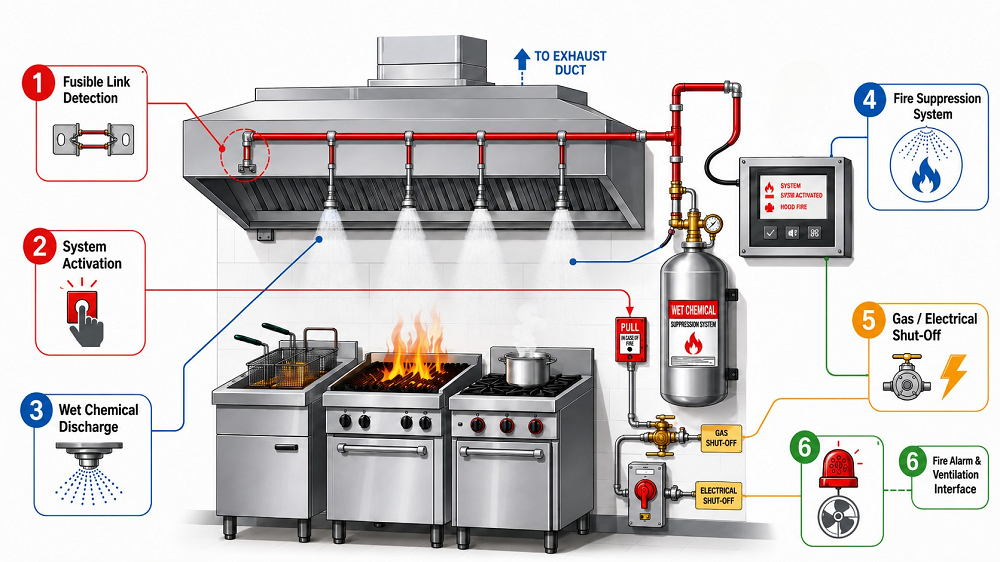
A kitchen hood suppression system works through a coordinated sequence: detection, activation, agent discharge, fire suppression and equipment shut-off. The exact design depends on the kitchen layout, cooking appliances, hood arrangement and approved system requirements.
1. Heat Detection
The system continuously monitors the protected cooking area through heat-sensitive detection components. Many systems use fusible links or approved heat detection devices positioned within the hood or exhaust path.
When the temperature rises beyond the designed activation point, the detection arrangement triggers the releasing mechanism.
2. System Activation
Once the detection system operates, the suppression system activates automatically. A manual release station is also normally provided so trained staff can activate the system if a fire is noticed before automatic activation occurs.
The manual release must remain visible, accessible and unobstructed at all times.
3. Wet Chemical Discharge
After activation, the system releases wet chemical agent from a dedicated cylinder through distribution piping and discharge nozzles. These nozzles are positioned to protect the exact cooking appliances and hazard areas included in the approved design.
Nozzle position is very important. A nozzle that is missing, blocked, moved or incorrectly aimed may affect the system’s performance.
4. Fire Suppression and Cooling
Wet chemical agent is used because commercial kitchen fires often involve hot oils and fats. The agent helps suppress the flame and creates a cooling, surface-securing effect over the burning cooking media.
This helps reduce the chance of the fire re-igniting after the visible flames are controlled.
5. Gas or Electrical Shut-Off
A properly designed kitchen hood suppression system may also shut down the gas or electrical supply to the protected cooking equipment. This is important because the fire cannot be controlled properly if the heat source continues operating after the agent is discharged.
The shut-off arrangement should be tested as part of the inspection and maintenance process.
6. Alarm and Ventilation Interfaces
Kitchen hood suppression systems may also be interfaced with the building fire alarm system and ventilation controls. Depending on the design, system activation can send a signal to the fire alarm panel and operate ventilation-related safety functions.
For complete building protection, the kitchen suppression system should not be treated as an isolated item. It should work together with the wider fire detection and suppression system installed in the facility.
Main Components of a Kitchen Hood Suppression System
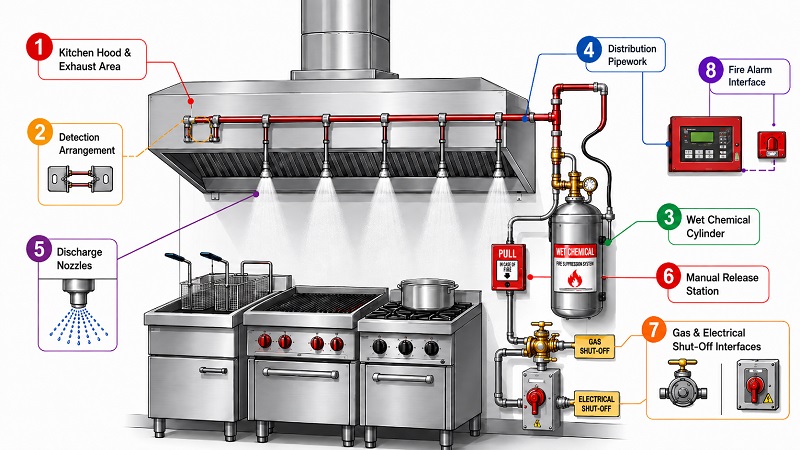
A kitchen hood suppression system includes several connected components. Each part must be selected, installed and maintained according to the approved design and manufacturer requirements.
1. Kitchen Hood and Exhaust Area
The hood captures smoke, grease vapour, heat and cooking by-products generated by commercial cooking. The suppression system is designed around the hood, filters, plenum and exhaust path where grease-related fire risk can develop.
2. Detection Arrangement
The detection system identifies abnormal heat conditions. If fusible links are used, their rating and location must match the protected hazard and approved design.
3. Wet Chemical Cylinder
The cylinder stores the required quantity of wet chemical suppression agent. The cylinder size and agent quantity depend on the protected cooking equipment and system design.
4. Distribution Pipework
Pipework carries the suppression agent from the cylinder to the discharge nozzles. Any change to pipework, routing or fittings must be reviewed by qualified personnel.
5. Discharge Nozzles
Nozzles release the wet chemical agent onto the protected cooking surfaces, appliances and required hazard areas. Nozzle caps should remain in place to prevent grease from blocking the nozzle outlet.
6. Manual Release Station
The manual release station allows trained staff to activate the system manually. It should be easy to reach and clearly visible.
7. Gas and Electrical Shut-Off Interfaces
These interfaces help stop the heat source when the system activates. Gas valves, contactors, relays or similar devices may be included depending on the cooking arrangement.
8. Fire Alarm Interface
Where required, the system can be connected to the building fire alarm system. This helps alert occupants and supports a coordinated emergency response.
For projects that require complete fire safety coordination, Cease Fire Solutions also supports fire alarm systems in Qatar and related fire protection services.
Where Kitchen Hood Suppression Systems Are Used
Kitchen hood suppression systems are used wherever commercial cooking creates grease, oil and high-heat fire hazards. They are especially important in kitchens that operate for long hours or serve large volumes of customers.
Common applications include restaurant kitchens, hotel kitchens, mall food courts, cafeterias, bakeries, catering facilities, staff kitchens, central kitchens, fast-food outlets and cloud kitchens.
The system should be designed based on the actual cooking equipment, not only the size of the kitchen. A fryer, wok range or charbroiler may require different protection from an oven, griddle or cooking range.
Before installation, the cooking line should be reviewed carefully to confirm the hood size, appliance type, appliance position, exhaust arrangement, fuel source and required system interfaces.
Kitchen Hood Suppression Requirements in Qatar
Commercial kitchen fire protection in Qatar should be handled as a coordinated fire safety system. The suppression arrangement, cooking appliances, gas or electrical shut-off, exhaust fan, make-up air, alarm interface and inspection documentation all matter.
For restaurants, hotels, cafés, commercial kitchens and food preparation facilities, the system should be installed according to the approved design, applicable local requirements, manufacturer instructions and recognized fire safety practices.
A compliant kitchen hood suppression installation should normally address:
- Protected cooking appliances
- Hood, plenum and exhaust duct coverage
- Wet chemical cylinder capacity
- Correct nozzle selection and placement
- Manual release station location
- Automatic detection arrangement
- Gas or electrical shut-off
- Fire alarm interface where required
- Ventilation interface where required
- Inspection, testing and maintenance records
If your kitchen is preparing for approval, renewal, renovation or inspection, Cease Fire Solutions can support you with Civil Defence certification renewal services and related fire protection system maintenance.
Design and Installation Considerations
A kitchen hood suppression system should never be selected from a catalogue without reviewing the actual kitchen. The system must match the cooking hazard.
Before installation, the following should be checked:
The type of cooking equipment, hood dimensions, appliance position, duct route, grease filter arrangement, fuel source, electrical control arrangement, available cylinder location, manual release access, alarm interface and future maintenance access.
The most common design issue occurs when kitchens change after installation. For example, a fryer may be replaced with a larger unit, a griddle may be moved, a new appliance may be added, or shelving may be installed near the hood. Even small changes can affect nozzle coverage and system performance.
If your cooking equipment layout changes, the suppression system should be reviewed before the kitchen continues full operation.
Cease Fire Solutions provides professional fire suppression system services in Qatar for facilities that need reliable design, supply, installation and maintenance support.
Inspection, Maintenance and Kitchen Hood Cleaning
A kitchen hood suppression system may remain unused for years, but it must work correctly the first time it is needed. This is why regular inspection and maintenance are essential.
A proper inspection should check the cylinder, agent level, detection line, fusible links, nozzles, nozzle caps, piping, manual release station, gas shut-off, electrical shut-off, alarm interface and ventilation-related functions.
Maintenance is also important after any discharge, renovation, appliance movement, visible damage or suspected system fault.
For more detailed maintenance guidance, you can read our related article on kitchen hood suppression system inspections.
Kitchen hood cleaning is also connected to fire risk management. Grease buildup inside hoods, filters, ducts and exhaust fans can increase fire exposure and reduce ventilation performance. Suppression maintenance and cleaning are different services, but they work together to keep the commercial kitchen safer.
Cease Fire Solutions also provides kitchen hood and duct cleaning services in Qatar for commercial kitchens that need professional cleaning, inspection support and documentation.
Kitchen Hood Suppression Is Part of a Complete Fire Safety System
A kitchen hood suppression system is a critical part of commercial kitchen fire protection, but it should not be the only safety measure.
A complete commercial kitchen fire safety plan may also include fire alarm systems, portable fire extinguishers, fire blankets, emergency lighting, exhaust cleaning, staff training, preventive maintenance and proper housekeeping.
Each system has a different role. A fire blanket may help in certain small, contained incidents. Portable and trolley fire extinguishers provide manual firefighting support. A fixed kitchen hood suppression system protects the cooking line automatically when the protected hazard reaches activation conditions.
The safest approach is coordinated protection: detection, suppression, shut-off, alarm, ventilation response, cleaning and maintenance working together.
Why Choose Cease Fire Solutions for Kitchen Hood Suppression Systems in Qatar?
Cease Fire Solutions supports commercial, residential and industrial clients with fire protection solutions across Qatar. For kitchen hood fire suppression systems, our team can assist with system selection, supply, installation, inspection, maintenance and related fire safety services.
When you work with Cease Fire Solutions, you get practical support from a fire protection team that understands the needs of restaurants, hotels, commercial kitchens, facility managers, contractors and building owners.
We can help with:
Kitchen hood suppression system supply and installation, inspection and maintenance, fire alarm interface support, fire suppression system services, kitchen hood and duct cleaning, fire extinguisher supply and servicing, and Civil Defence renewal support.
If you are opening a new kitchen, upgrading an existing restaurant, preparing for inspection or reviewing your fire safety systems, our team can help you choose the right solution.
Need support with a kitchen hood suppression system in Qatar?
Call Cease Fire Solutions at +974 55324195 or email sales@ceasefireme.com to discuss your requirement.
Comments are closed